Early Orthodontic Treatment for Children in Sandgate
Early orthodontic treatment guides the growth of a child’s jaws while they are still developing.
At Dental Seasons, we assess your child’s jaw development, airway and dental alignment before recommending a plan, which may include an expander appliance.
For teenagers and adults, see our teeth straightening page.
Records include our on-site 3D CBCT imaging.
Expanders guide jaw development rather than directly moving teeth, so later orthodontic treatment may still be recommended. No referral is needed to book.
New families welcome.



What is early orthodontic treatment?
Early orthodontic treatment, sometimes called phase one treatment, begins while a child’s jaws are still growing.
We take a structured, step-by-step approach to understand your child’s development and choose the most appropriate care. The focus is not only on straightening teeth, but on guiding how the jaws develop, creating space for permanent teeth and supporting a healthy bite.
Children with narrow or underdeveloped jaws can be at higher risk of crowding, mouth breathing, sleep-disordered breathing, clenching or grinding, and other oral habits.
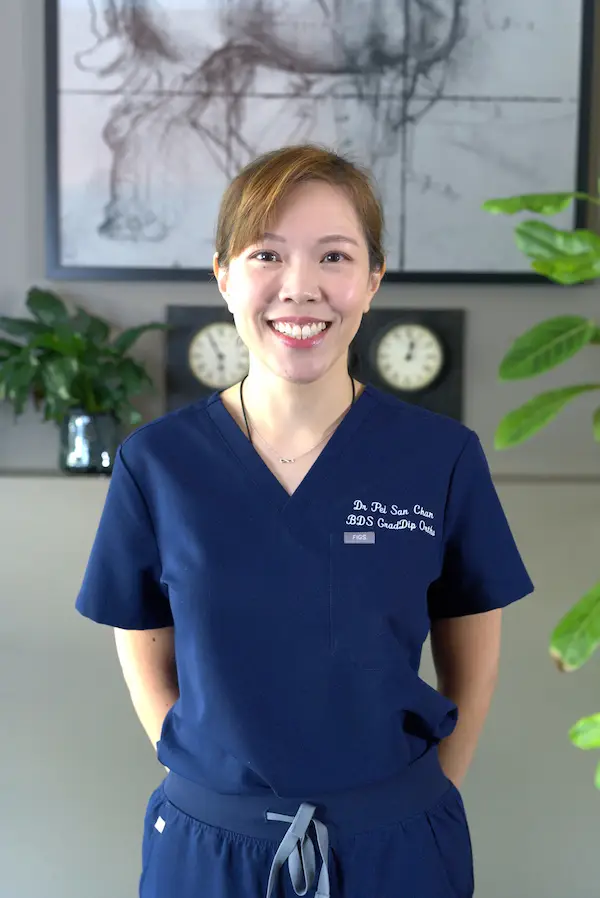
Our dentists are Dr Andrew Bachour and Dr Pei San Chan, who both treat children in this way.
Signs your child may benefit from an assessment
Crowded teeth
Teeth that overlap or appear to have too little room to come through.
A narrow upper jaw
A narrow palate or a bite where the upper and lower teeth do not meet evenly.
Mouth breathing or snoring
Breathing through the mouth, snoring or restless sleep can have several causes and should be assessed.
Clenching or grinding
Grinding or clenching teeth during the day or while asleep.
Oral habits
Habits such as thumb sucking or tongue thrusting that may affect jaw and bite development.
Teeth coming through unevenly
Adult teeth erupting out of position or at different times.
Expanders guide jaw growth, not just teeth

In many cases, early treatment uses an expander appliance. It gently applies pressure to the jaw bones to encourage growth and create more space.
Because the focus is on developing the jaw, it is normal for spaces to appear between the teeth during treatment. Further orthodontic treatment may be recommended later to fine-tune tooth alignment.
Treatment is planned around each child’s growth, so some children need further treatment later and some do not.
Our step-by-step approach
Initial consultation
A brief assessment and a discussion of the general treatment approach.
Diagnostic appointment
If treatment is likely to be helpful, we collect photographs, measurements and a 3D CBCT scan to assess jaw development, airway and dental alignment in detail.
Treatment presentation
We review our findings with you, explain the recommended plan and answer your questions so you can make an informed decision.
Treatment and review
Your child’s appliance is fitted, with regular monthly review and adjustment appointments to keep progress on track.
How expanders work
An expander gently applies pressure to the jaw bones to encourage growth and create more space.
Depending on your child, expansion may involve the upper jaw (palate), the lower jaw, or both.
In most cases we prefer a removable appliance, although a fixed option may be more suitable in some situations.
Expanders are designed to guide jaw development rather than directly move teeth. Creating more space in the jaws may reduce the likelihood of crowding as permanent teeth come through.
Depending on your child’s growth pattern and skeletal development, we may recommend alternative or additional appliances to guide jaw development.
How long does treatment take?
Treatment with an expander typically takes around 12 to 18 months, although each child is different.
Regular monthly review and adjustment appointments help ensure progress is on track.
Some children may not need further treatment if growth continues favourably. Others may benefit from a second phase later on.
What is the best age to start?
Early intervention can be helpful because the jaws are still developing and more responsive to guidance. At younger ages, treatment focuses on creating space and directing growth.
Some children can start as early as four years old. We generally find the most cooperative age group is between 6 and 9 years, which is why this is often the ideal time to begin.
The right time also depends on your child’s ability to cooperate with treatment.
Airway and breathing assessment
As part of the assessment we look at your child’s breathing and airway using clinical assessment and 3D imaging.
If we have concerns about mouth breathing, snoring or disturbed sleep, we may recommend your child sees their GP or an ENT specialist. Expansion may be considered as one part of a wider plan, but it is not a treatment for sleep apnoea and will not suit every child with breathing problems.
Getting used to an expander
It takes a little time to get used to wearing an expander. Eating and speaking may feel different at first.
Soft foods and cutting food into small pieces can help while your child adjusts. Spaces between the teeth are a normal part of this stage of treatment.
Risks and limitations
Possible effects and limitations include:
- Discomfort or soreness after adjustments
- Temporary changes in speech
- Getting used to eating with the appliance
- Gaps between the teeth
- Appliance breakage or loss
- Difficulty cleaning around the appliance
- Results that vary between children
- Later braces or aligners being recommended
- Treatment depending on your child’s cooperation
3D CBCT imaging
A 3D CBCT scan is part of the diagnostic records. It helps us assess jaw development, airway and tooth position in more detail than standard images.
CBCT uses ionising radiation. We keep exposure as low as reasonably achievable and explain what the scan involves before it is taken.
Related care
Early orthodontic treatment sits alongside our children’s dental care and wider dentofacial orthodontics services. Teenagers and adults may be suited to Invisalign clear aligners.
Early orthodontic care in Sandgate
Dental Seasons is located at 119A Brighton Road, Sandgate QLD 4017.
We provide early orthodontic assessment and treatment for children from Sandgate and surrounding North Brisbane and bayside suburbs, including Brighton, Deagon, Shorncliffe, Bracken Ridge, Boondall, Taigum, Nudgee, Zillmere, Fitzgibbon, Banyo, Virginia, Redcliffe, Woody Point, Clontarf, Margate and Newport.
No referral is needed to book a consultation.
Early orthodontic treatment questions
What age is best for early orthodontic treatment?
Some children can start as early as four, but we generally find the most cooperative age group is between 6 and 9. The ideal time also depends on how well your child can cooperate with treatment.
Do we need a referral?
No. You can book a consultation with us directly, without a referral.
What is an expander?
An expander is an appliance that gently applies pressure to the jaw bones to encourage growth and create more space. It can be used in the upper jaw, the lower jaw, or both.
Will my child need braces later?
Possibly. Expanders guide jaw development rather than directly moving teeth, so further orthodontic treatment may be recommended later. Some children do not need further treatment if growth continues favourably, while others benefit from a second phase.
How long does treatment take?
Treatment with an expander typically takes around 12 to 18 months, although each child is different. Regular monthly review and adjustment appointments keep progress on track.
Are expanders removable?
In most cases we prefer to use a removable appliance, although a fixed option may be more suitable in some situations.
Why are there gaps between my child’s teeth?
Expanders create space in the jaws to guide development, so spaces between the teeth are normal during this phase. Further orthodontic treatment may be recommended later to fine-tune tooth alignment.
Is it uncomfortable?
Some soreness after adjustments is common. Eating and speaking may feel different at first, and most children need a little time to get used to the appliance.
Does early treatment help mouth breathing or sleep problems?
We assess your child’s airway and breathing as part of the diagnostic process. Mouth breathing and disturbed sleep can have several causes, so we may recommend your child sees their GP or an ENT specialist. Expansion may be considered as part of a wider plan, but results vary and it is not a treatment for sleep apnoea.
What happens at the first appointment?
The first appointment is a brief assessment and a discussion of the general treatment approach. If treatment is likely to be helpful, the next step is a diagnostic appointment where we collect records, including a 3D CBCT scan.


Thinking about early orthodontic treatment for your child?
The first step is understanding how your child’s jaws and teeth are developing. Book a consultation at Dental Seasons and we will explain whether early treatment is likely to help.
Meet the dentists who guide your child’s development
Dr Andrew Bachour and Dr Pei San Chan both have additional training in orthodontics and dentofacial orthopaedics, and both treat children in this way. Both are registered dentists with general registration. Check the Ahpra register.