Jaw Pain and Orofacial Pain Assessment in Sandgate
Jaw pain, clicking or locking, muscle pain, headaches and ear pain can all be related to the jaw joints (TMJ) and the muscles around them.
Dr Andrew Bachour starts with a thorough history and an examination of your jaw, then discusses the options that may help you.
There are many possible options, and they are discussed after diagnostics. If another health professional would be better placed to help, we refer you.
New patients welcome.


What is the TMJ?
The temporomandibular joints (TMJs) are the two joints on either side of your face, just in front of your ears, that connect your lower jaw to your skull. Together with the jaw muscles, they allow you to chew, speak and yawn.
Problems with these joints and muscles are often grouped under the term temporomandibular disorders (TMD). Pain in this area can come from the joint, the muscles, or both, and sometimes from other causes.
Symptoms we assess
Jaw pain
Pain in or around the jaw joints, especially when chewing or opening wide.
Clicking or popping
Noises from the jaw joints. Painless clicking is common and does not always need action.
Locking or limited opening
The jaw catching, locking or not opening as widely as usual.
Muscle pain
Aching or tightness in the face, temples or neck.
Headaches
Some headaches may be related to the jaw muscles or joints. Headaches have many causes, so your GP may also need to be involved.
Ear pain
Ear pain or fullness can sometimes be related to the jaw. Ear problems should also be checked by your GP.
Every jaw problem is different
Jaw pain can have many causes, so we begin by understanding your full history before recommending anything.
After assessment and diagnostics, we discuss the options that may help. These can include a splint, but there are many possible approaches.
If another health professional would be better placed to help, we refer you.
How we assess your jaw
A full history
We take a full history of your jaw, including when symptoms started, what makes them better or worse, and any past injuries or treatment.
Examination
We examine how your jaw moves, the joints, the muscles, your bite and your teeth.
Diagnostics
We usually use a 3D CBCT scan to look closely at the jaw joints.
Discussion of options
We explain what we found and discuss the options that may help, and any referral that may be useful.
Options we may discuss
There are many possible options, and which ones are appropriate depends on your diagnosis. They are discussed with you after diagnostics. We do not recommend any option before we understand what is causing your symptoms.
One option that is often discussed is a splint.
About splints
A splint is a custom-made oral appliance worn over the teeth.
Depending on your diagnosis, a splint may be worn day and night, or sometimes just at night. A day splint is a temporary measure, not a long-term solution.
Splints do not suit everyone, and possible effects include soreness, extra saliva, changes in how the teeth fit together and a period of adjustment. We review how you are going and advise what is appropriate for you.
When we refer you
If your symptoms suggest another cause, or another health professional would be better placed to help, we refer you.
Seek urgent medical care, or call 000, if jaw pain comes with chest pain, shortness of breath, pain spreading to your arm, or swelling that makes it hard to breathe or swallow.
Jaw pain or toothache?
Pain in the jaw can also come from the teeth or gums. If you have a toothache, see our emergency dentist page, or read about root canal treatment.
Related care
Read more about teeth grinding and clenching, our wider TMJ and sleep-related care, sleep apnoea and snoring assessments and 3D CBCT imaging.
Jaw pain assessment in Sandgate
Dental Seasons is located at 119A Brighton Road, Sandgate QLD 4017.
We assess jaw pain for patients from Sandgate and surrounding North Brisbane and bayside suburbs, including Brighton, Deagon, Shorncliffe, Bracken Ridge, Boondall, Taigum, Nudgee, Zillmere, Fitzgibbon, Banyo, Virginia, Redcliffe, Woody Point, Clontarf, Margate and Newport.
Jaw pain questions
What causes jaw pain?
There are many possible causes, including problems with the jaw joint, tight or overworked jaw muscles, clenching or grinding, injury and dental problems. A thorough assessment is needed to understand what is happening.
Who will assess my jaw?
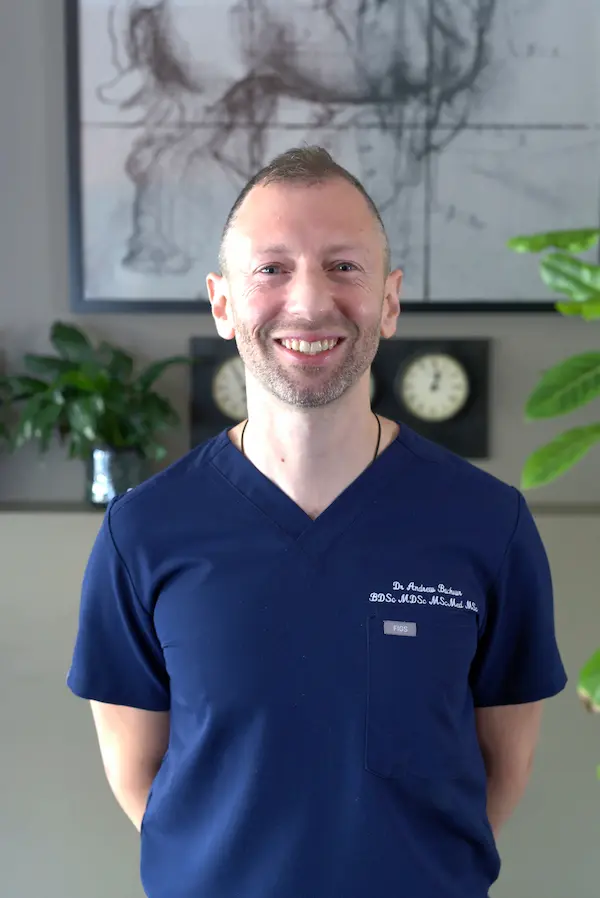
Dr Andrew Bachour assesses jaw pain and related symptoms at Dental Seasons. He begins with a thorough history of your jaw.
Do I need a scan?
We usually use a 3D CBCT scan as part of the diagnostics, so we can look closely at the jaw joints. Your dentist explains why it is recommended before it is taken.
What is a splint?
A splint is a custom-made oral appliance worn over the teeth. It is one of several options that may be discussed after diagnostics, and it does not suit everyone.
Do you assess jaw clicking?
Yes. Jaw clicking without pain is common and does not always need action. We assess it as part of a full history and examination of your jaw.
How long do I wear a splint?
It depends on your diagnosis. A splint may be worn day and night, or sometimes just at night. A day splint is a temporary measure, not a long-term solution.
Can jaw problems cause headaches?
Some headaches may be related to the jaw muscles or joints. Headaches have many causes, so we may recommend you also see your GP.
Can jaw problems cause ear pain?
Ear pain can sometimes be related to the jaw. Because ear pain has many causes, ear problems should also be checked by your GP.
Will I be referred to someone else?
If it is indicated, yes. If another health professional would be better placed to help, we refer you.
Can you guarantee my jaw pain will go away?
No. Results vary between people. The aim is to understand what is causing your symptoms and discuss the options that may help.


Struggling with jaw pain?
If you have jaw pain, clicking, locking, muscle pain, headaches or ear pain, book an assessment with Dr Bachour. We will take a full history, assess your jaw and discuss the options that may help.
Meet Dr Bachour and the team
Dr Andrew Bachour assesses jaw pain and related symptoms at Dental Seasons. He is a registered dentist with general registration (Ahpra DEN0000972458). Check the Ahpra register.